



If you live in a bigger property with multiple bathrooms, a busy household or simply more radiators to heat, choosing the right boiler isn’t always straightforward. We’re often asked whether system boiler installation is the best route for larger homes. The short answer is it can be, but it depends on how your home uses hot water and heating day to day.
In this guide, we’ll break down how system boilers work, why they’re popular in medium to large houses and what you should weigh up before making a decision.
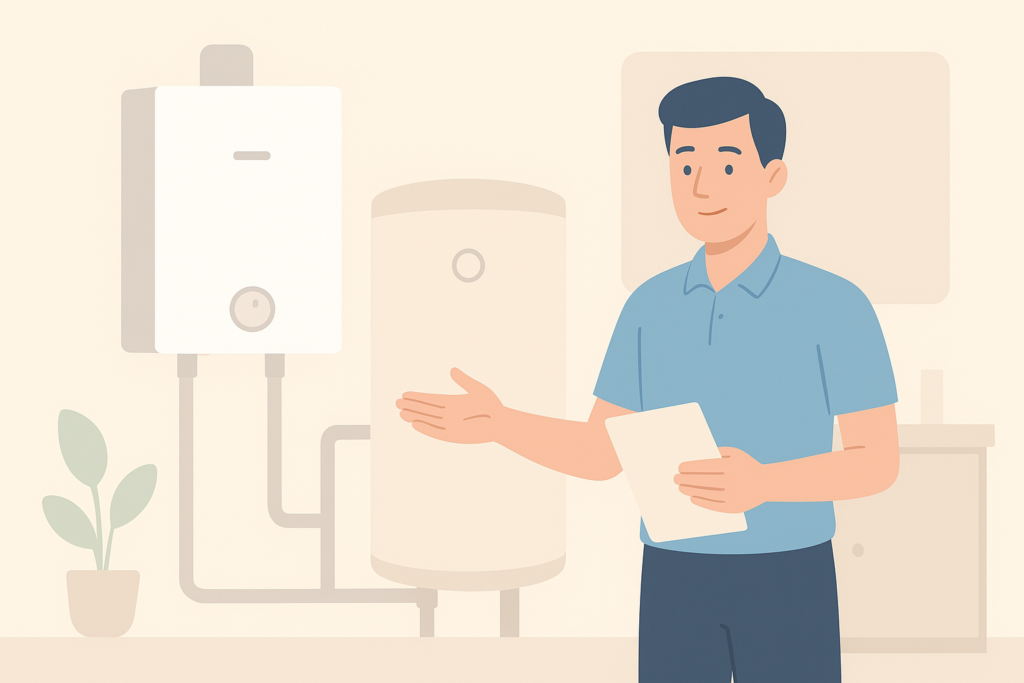
What Is A System Boiler And How Does It Work?
A system boiler works alongside a separate hot water cylinder, usually stored in an airing cupboard or dedicated cupboard space. Unlike a regular boiler, most of the key components are built into the unit itself, such as the pump and expansion vessel.
In simple terms, the boiler heats water and stores it in the cylinder ready for when you turn on a tap or shower. That means you can run multiple outlets at once without the pressure dropping off in the way it might with a smaller combi in a larger home.
We still come across older conventional systems in bigger houses around Worksop and Bolsover, particularly in properties built in the 70s and 80s. In many of those homes, upgrading to a modern system boiler makes practical sense because the pipework layout already suits a stored hot water setup.
Why Larger Homes May Benefit From A System Boiler
Bigger homes usually mean more bathrooms, more radiators and higher overall hot water demand. A combi boiler can struggle if two or three showers are being used at the same time. That’s where a system boiler comes into its own.
Because hot water is stored in a cylinder, it’s available at mains pressure to multiple outlets at once. In a four bedroom home with an en suite, family bathroom and downstairs cloakroom, that can make a real difference on busy mornings.
We’ve fitted plenty of system boilers in and around Worksop and Clay Cross where homeowners were simply fed up with arguments over who used all the hot water. Once a correctly sized cylinder is in place, those problems usually disappear.
Better For Higher Water Demand
If your household regularly:
- Uses two or more showers at the same time
- Has large corner baths that take time to fill
- Needs strong, steady pressure upstairs
- Runs washing machines and dishwashers during peak times
Then a system boiler with an appropriately sized cylinder is often a sensible option.
Key Advantages And Potential Drawbacks To Consider
No heating system is perfect for every situation, so it’s worth looking at both sides before deciding if a system boiler is right for you.
Advantages
One of the biggest benefits is performance. With stored hot water, you’re not relying on the boiler to heat it instantly each time you turn on a tap. That tends to give more consistent pressure and temperature.
System boilers are also cleaner to install than older regular systems because fewer external components are needed. The built in expansion vessel reduces clutter in airing cupboards.
They also work well alongside modern controls and can be paired with unvented cylinders for strong mains pressure throughout the property.
Potential Drawbacks
The main consideration is space. You will need somewhere suitable for the hot water cylinder. In some larger homes that’s not an issue. In others, especially where someone wants to convert an airing cupboard into storage, it can be a sticking point.
There’s also the fact that once the stored water is used up, you’ll need to wait while it reheats. This isn’t often a problem if the cylinder is sized correctly, but it’s something to bear in mind.
How To Decide If A System Boiler Is Right For Your Home
When customers ask us, “Is A System Boiler Right For A Larger Home?” we usually start with a few practical questions rather than jumping to a recommendation.
How many bathrooms do you have? How many people live in the property? Are you planning an extension or loft conversion? What’s your current setup and how well is it performing?
If you’ve already got a conventional boiler and cylinder arrangement and it’s meeting your demand, switching to a modern system boiler is often a straightforward upgrade.
If you’re replacing a combi that’s struggling in a large property, moving to a system could solve low pressure issues and constant temperature fluctuations.
On the other hand, if there’s only one bathroom and limited space, a high output combi might still be enough. It really comes down to usage patterns rather than just the square footage of the house.
While you’re weighing up options, it can also help to look at alternatives such as oil boilers if you’re off the gas grid or in more rural areas.
Installation Considerations And Next Steps
A proper assessment is key before any installation. An engineer should check incoming mains pressure, existing pipework size and radiator capacity. In older properties around Bolsover and Clay Cross, we sometimes find undersized gas supplies that need upgrading before a higher output boiler can be fitted safely.
Cylinder size also matters. A family of five with two power showers will need something very different to a retired couple in the same size property. Getting that detail right is what makes a system boiler feel effortless rather than frustrating.
If you’re considering replacing your current boiler and want clear advice without sales pressure, speaking to a local engineer who understands the types of homes in this area is a good starting point. At Paul Caton Gas & Oil Services, we regularly advise homeowners on whether a system boiler is the right fit based on real usage, not guesswork.
Get in touch today to arrange your boiler service or request a quote for a new boiler and installation.